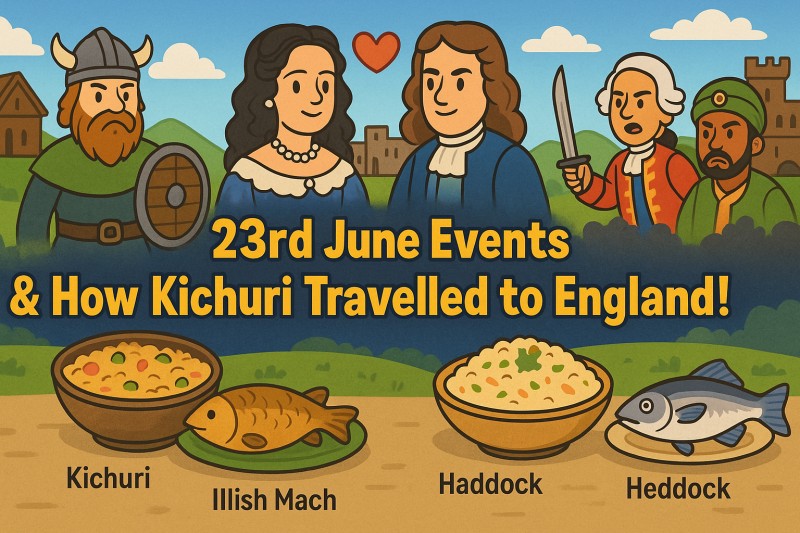

Discover exciting historical events of 23rd June and the fascinating story of how our beloved Kichuri travelled all the way to the royal palace in England, transforming into the famous Kedgeree! Perfect reading for curious young minds.
Dear Students,
I promised you yesterday that I will tell you how your favourite comfort food—Kichuri—ended up on the royal dining table in England? Well, hold on to your spoons, because I’ll tell you that tale shortly. But first, let’s dive into some amazing historical events that happened on 23rd June over the years!
🏛️ 930 AD – The World’s Oldest Parliament is Born!
On 23rd June in the year 930, the world’s oldest parliament was established in Iceland! It was called the Alþingi (say it like “Al-thing-ee”), and people would gather outdoors to make important decisions for their land. That’s like a giant school council meeting, but with Vikings!

⚔️ 1757 – The Battle of Plassey
This was a turning point in Indian history. On 23rd June 1757, brave Nawab Siraj-ud-Daulah was killed by the British East India Company led by Robert Clive at the Battle of Plassey. Siraj was betrayed by quite a few including Raja Krishna Chandra, Mir Jafar, the Jagat Seth (Money Lending society) and some more. But what happened next might surprise you, wait till the end …

⌨️ 1868 – Birth of the Typewriter
Ever typed something on a keyboard? You can thank Christopher Latham Sholes, who patented the typewriter on 23rd June 1868! Without him, we might still be writing everything by hand—including this very article!

🇮🇳 1930 – Simon Commission’s Big Report
On this day in 1930, the Simon Commission presented a report suggesting India should become a federation and that Burma (now Myanmar) should be separated. This report later shaped the Government of India Act, 1935, which was a step towards India’s independence.

🌍 2014 – Two Indian Gems Join UNESCO!
On 23rd June 2014, two Indian treasures were added to the UNESCO World Heritage List:
- Rani ki Vav (a beautiful stepwell in Gujarat) for its cultural beauty
- Great Himalayan National Park for its amazing biodiversity
They are now officially recognised as wonders of the world!
🍛 Now, How Did Kichuri Travel to England?
Let’s go back to that turning point in history—the Battle of Plassey. After winning the battle like a coward Robert Clive looted the treasures of Nawab Siraj, and suddenly became super rich. He wanted to thank the Almighty, but since many churches had been destroyed by Siraj, he turned to a local fellow in Calcutta —Nabakrishna Deb.
Deb invited Clive to his home during Durga Puja, and served him a grand feast that included—yes, you guessed it—as some historians say he was served Kichuri with Ilish Maach Bhaja (fried Hilsa fish). Clive loved it so much that when he returned to England, he took the recipe with him!
But there was a twist! The Ilish, being a proud Swadeshi Bengali fish, refused to lay eggs or live happily in the Bideshi water of England. By this time the repute of Kichuri and Ilish Mach Bhaja had reached the royal family. So the royal chefs had to look for a replacement. They experimented with many fishes and finally found one—Haddock (not Captain Haddock from Tintin, mind you!).
They poached it, steamed it, even smoked it—and cooked it with curry powder and cream and rice. The dish was a hit in the British Royal Palace, and today it’s called Kedgeree—the royal cousin of our very own Kichuri!
🥄 So Next Time You Eat Kichuri…
…just remember, you’re having a dish so delicious that even kings and queens across the world couldn’t resist it! From the battlefields of Bengal to the royal banquets of Britain, Kichuri truly made history.
With warmth and wonder.



Ecuador Stun Germany FIFA - 25th June - Epic Words
[…] New Jersey: Ecuador produced a spirited comeback to defeat Germany 2–1 and book their place in the FIFA World Cup knockout stage, keeping alive hopes of a memorable campaign. The victory sets up a potential last-16 clash with England. […]