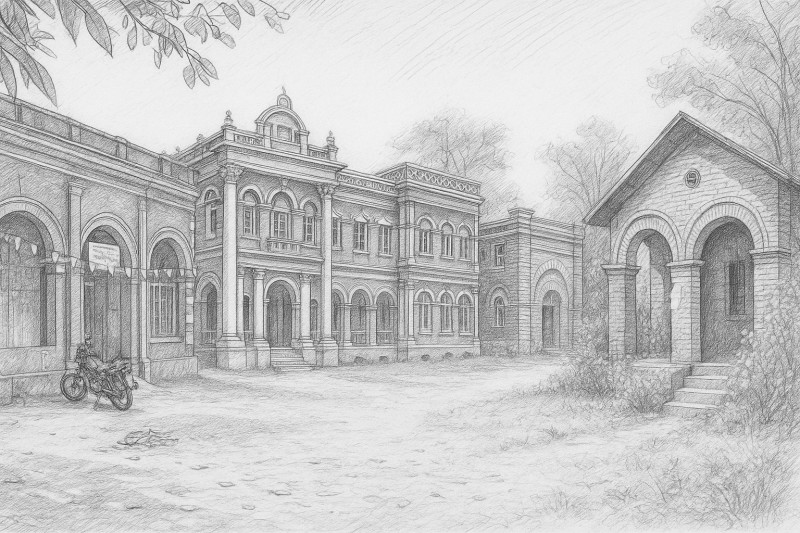

Discover the hidden heritage of Cooch Behar through a fascinating walk across ten historic landmarks, from ancient palaces to the town’s first post office, waterworks, and more—written especially for the students with curiosity and pride in their hometown.
Dear Students,
You must have been reading the history series which I share with you every day. There I share stories all across the world —tales of mighty empires in Europe, ancient civilisations in Africa, and revolutions in America. But while going through some old documents recently, it struck me—why not explore the heritage of the very place you live in, your own Cooch Behar?
So here I am, with a little walk down memory lane. Today, I’ll be your guide through ten very special places in your beloved town—each of them with stories waiting to be rediscovered.
🏠 The House on PVNN Road
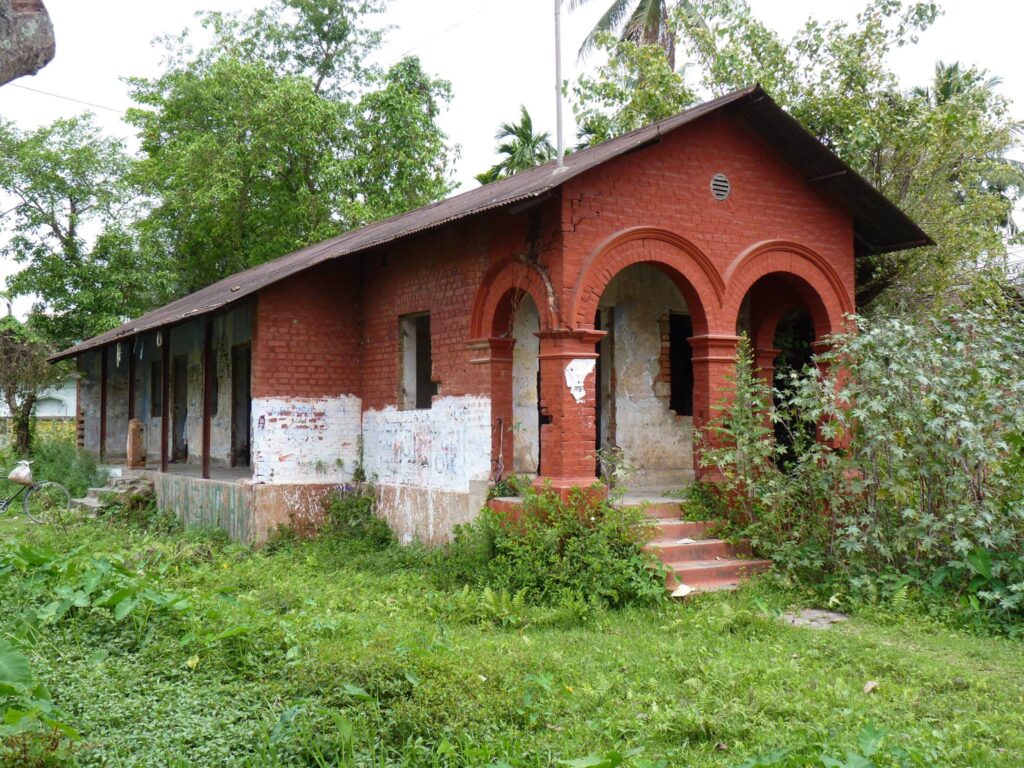
Let’s begin with a road all of you know—Prince Victor Nityendra Narayan Road, or PVNN Road. Just opposite the historic Sunity Academy for girls stands a house that many of you might have passed without a second glance. But did you know this was once the residence of the Assistant Mistress of Sunity Academy, built way back in 1941-42?
It was a well-planned structure with two rooms, two verandas, a covered bathing platform, and a pucca washroom—luxuries in those days. Built with C.I. (corrugated iron) roofing on sturdy brick walls, it cost Rs 4,283, just a few rupees short of the Rs 4,300 that was sanctioned. In today’s terms, that would be roughly five lakh rupees!
🚌 The Birth of Public Transport
You may ride on buses every day, but how many of you know when Cooch Behar got its first buses? Public transport began here on 2 April 1945, under the name State Motor Services, with buses running from Soulmari-Falakata to Cooch Behar. It started with just three buses and three trucks.
Before that, a private company, the Cooch Behar Transport Company Ltd, was operating since the early 1930s. In fact, Cooch Behar even had its own Motor Vehicles Act in 1932! Regular bus services to Siliguri only began by mid-1948.

🏛 Khasmahal – The Administrative Block
South of Sagardighi Square lies Khasmahal, a building many of you walk past. Constructed in 1941-42, it housed offices for Tehsildars and officials, with rooms for correspondence, accounts, records, and meetings.
Built with masonry and RC slab roofing finished with lime terracing, it cost Rs 22,910 to construct. It even had a lavatory, urinals, and verandas on three sides. Fancy that!

📮 The Head Post Office
If you’ve ever visited the Cooch Behar Head Post Office near your school, you’re stepping into a bit of history. This two-storey building was completed in 1923-24 at a total cost of Rs 78,652—a huge amount at the time.
Its spacious Central Hall (55’ x 40’) served as the main postal area, with rooms for a telephonic exchange, a battery room, and a record room at the back. The outer walls were surrounded by seven-foot-wide verandahs, although the first-floor veranda has now been enclosed into rooms.

🕰️ Lansdowne Hall – Town Hall and Clock Tower
Built in 1894, this iconic building on the Sagardighi West was named after Lord Lansdowne, Viceroy of India, who visited Cooch Behar. The ground floor became the State Library, opened with much pomp by Maharaja Nripendra Narayan, while the upper floor was used by the Masonic Lodge.
Its Italian architecture featured a three-storey-high carriage porch with a clock tower, which unfortunately collapsed during the great Assam earthquake of 1897. The hall inside measured an impressive 92.5 feet by 25 feet, with side aisles and decorative crests. It served as the Town Hall and reading room until the 1980s.

🎩 Jitendra Narayan Club
Situated at the eastern end of Sunity Road, this club was built during 1941-42 as a social and sports club. The foundation stone was laid by the King of Sirmoor, with Maharaja Jagaddipendra Narayan and several dignitaries in attendance.
It cost Rs 46,453, and an additional Rs 1,728 was spent on furniture. The building was thoughtfully designed to withstand earthquakes, with flat RC slab roofs, banded masonry, and fencing around its boundary.

🏰 Dewankhana – The Palace of Ideas
Located on the north-west corner of Sagardighi Square, this majestic Italian-style building was originally the residence of the Dewan of Cooch Behar. Built in 1894-95, it hosted famous thinkers like Keshab Chandra Sen and Pandit Ramkumar Vidyaratna.
Later, Prince Victor Nityendra Narayan, son of Maharaja Nripendra Narayan and Sunity Devi, made it their home. He founded the Cooch Behar Sahitya Sabha in 1915, which focused on preserving history, literature, and culture. His wife, Nirupama Devi, was a poet and editor of the literary journal Paricharika.

🏫 Old PWD Building – From College to Council
Near the Sunity Tank (Bairagi Dighi) stands a building built by Messrs Merrilier & Edwards over a century ago. It began as a residence for palace engineers but became the first home of Victoria College in 1888.
The college started with 16 students and 5 professors. It had stables, servant quarters, a tennis court—even a carriage shed! After the 1897 earthquake, one building was destroyed, and the college moved to its present campus in 1906. The old building became the Royal PWD Headquarters.
🐄 The Model Dairy
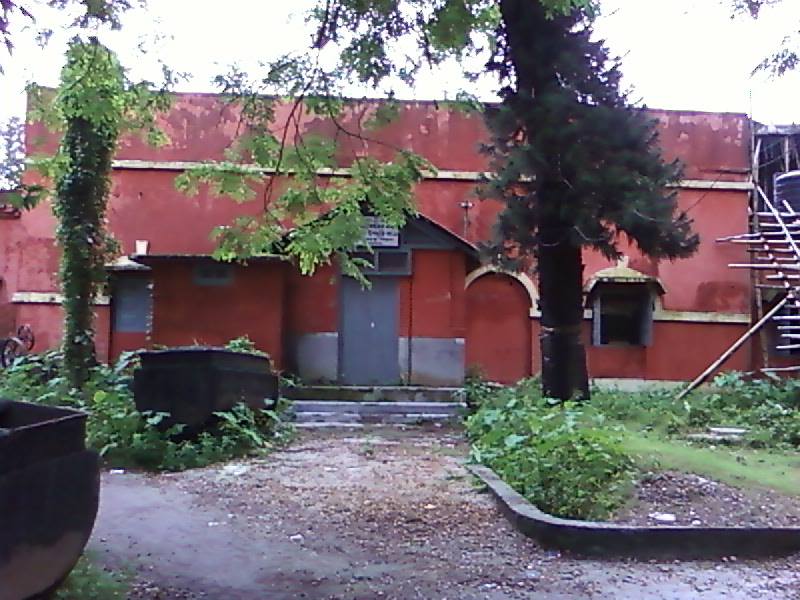
Now functioning as the Police Hospital, this area once served as the Model Dairy, set up in 1939 to provide milk, butter, and ghee to hospitals, schools, and even the royal palace. It was inspired by the famous Keventer’s Dairies.
Before that, the entire stretch was part of the military lines, with sentry posts (still visible today), army barracks, and a parade ground—what we now know as the Rashmela Maidan.

💧 Water Works – A Fountain of Life
The water supply system of Cooch Behar began with a dream of Maharaja Nripendra Narayan and was taken forward by Maharaja Jitendra Narayan. In 1925, Major Plowden invited British engineer Mr G Bransby Williams to design a modern water supply system.
The plan was massive: Rs 2.5 lakhs were set aside for construction, and by 1928-29, a majestic octagonal water tank stood in the Narendra Narayan Park. Built by Glenfield & Kennedy of Kilmarnock, Scotland, it could hold 60,000 gallons of water, with a height of 85 feet! Many of the old cast iron water posts still dot your town, if you keep your eyes open.

In Conclusion
So, dear students, as you ride your bicycle past the Post Office, wait for a bus near Sagardighi, or attend school near Sunity Academy—know that the roads you walk on and the buildings you see are alive with history.
Cooch Behar is not just your hometown—it’s a living museum of people, events, and ideas that shaped our present. If you listen closely, the walls may still whisper their secrets.
Until next time,
Keep walking, keep wondering!
All pictures and information sources Cooch Behar Heritage Society.