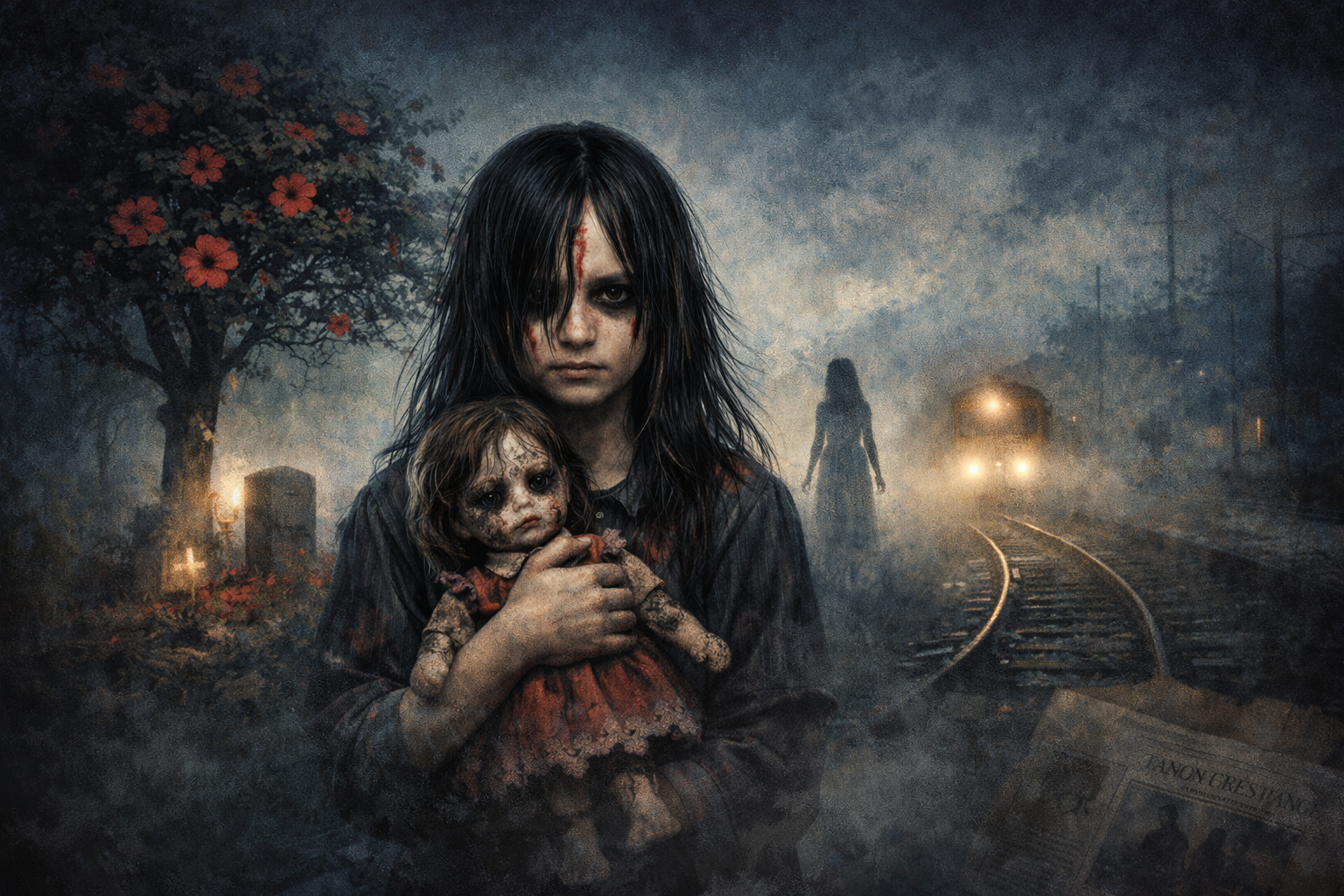

“Sometimes, Our Eyes Even Lie” is a heartfelt short story by Purba Nandi of class 7. Epic Public School that explores the emotional complexities within a Bengali household, generational tensions over marriage, and a poignant encounter with a stranger who hides his inner pain behind a cheerful smile.
“Maa, I’m back,” I said, my eyes to sleepy, my hand holding a red bag in one hand and two files in the other.
“Take a shower, your food is on the table. And don’t disturb us,” she shouted from the bedroom, with her big eyes showing what she meant—as if she’d forgotten she even had a child.
I slammed the door and dropped my bag and files on the table. I flopped onto the sofa and pulled off my dirty socks.
This had become the norm in our house. As soon as I returned from work, my parents would forget me and behave like children. Yeah, I know there’s a reason—and it’s quite obvious in a desi household. As soon as parents find out their children are ‘settled’, they want them married. And if they refuse they will roll their eyes. But why?
My phone pinged with a notification. As I took it out, the first thing I noticed was my wallpaper—a picture of my dad carrying my school bag on his shoulders, and me in my mother’s lap on the way to my first day of school. Probably taken twenty years ago by my aunt with one of those newly launched cameras.
The notification was from my boss, Sahan:
“Please come tomorrow with the presentation ready…”
The message ended with three dots. Always ominous.
“My life is so screwed,” I muttered, glancing at the vintage clock on the wall. It had a Portuguese vibe and was quite eye-catching.
“Seriously? It’s 7:45 p.m.? How can time move so fast!” I shouted.
“Just like you became so old,” Dad suddenly said, appearing out of nowhere as he pulled bottles out of the fridge.
“Ha-ha, so funny, Baba. What’s your issue?” I replied, clearly irritated.
“You!” he smirked.
“Yeah, yeah, go watch IPL and Vaibhav Suryavanshi,” I said finally.
The match was probably two days old, where fourteen-year-old Vaibhav scored a century. But my Baba—sorry, forgot to introduce Mr. Ranjan Kumar Banerjee, ex-loco pilot and current businessman—is obsessed with other people’s marriages (especially mine) and can’t stop watching that match. Probably the 17th replay.
“Sonai, don’t be rude. He’s your father, after all,” Maa said, popping up from nowhere.
“But Maa, he—” I began.
“No ‘but’, ‘but’. And what is this, Sonai? I told you to take a shower! You’re still in your formals!” Maa shouted like a professional debater you can never win against.
“Yeah, yeah. I’m going. And please, don’t scare me by suddenly appearing again—I’ll get a heart attack or something.”
“Get a life,” Baba muttered as he headed toward the bedroom.
“Seriously,” Ma muttered after him, disappearing behind the door.
My mother, Mrs. Kakali Ghosh Banerjee, is a typical Bengali mother and a poet. Obsessed with poems and equally obsessed with getting me married…
I went to the bathroom and took a long, relaxing shower.
Back in my room, mopping my head with a towel, I changed into shorts and jumped onto my bed.
“I’ve got a good body. I should really continue gym,” I thought, looking at my stomach.
“Oh yes, Sonai! There’s a marriage—Tuntun Kaki’s sister’s daughter. We’re getting ready, you get ready too,” Maa’s voice broke my chain of thought.
“But wait—didn’t she get divorced just a few days ago?” I asked while scrolling through some messages.
“Yeah, but I think she had an affair. So, as soon as she got divorced, she’s ready to marry again. And the boy is sanskari,” Maa replied, eyeing my dirty socks on the sofa.
“And you and Baba are going? Have some shame,” I said, bending down to grab the comb from the side table.
“They insisted, Sonai! Said they wouldn’t sit for the wedding unless we came,” she replied excitedly.
“They’ll sit whether you go or not,” I mumbled under my breath.
“WHAT?” Maa asked, confused.
“Huh? Nothing. You both go and enjoy. I’m staying back,” I said finally.
“Sonai, my word is final. If you don’t agree, no dinner tonight—just sleep,” Maa declared, slamming the door behind her.
“But! Please…” I began, then sighed. I knew the “please” was useless.
“Not again. I have to change my clothes,” I thought.
You might think I’m lazy. And, well… you’d be right.
Anyway—
Hi! I’m Ruv Ghosh Banerjee, an editor at Bee 24. Beloved son. Aspiring author. Daydreamer. Writer.
I quickly changed back into formals.
“Ruv, not ready yet?” Maa shouted, as if I were the groom.
“Yes, yes!” I shouted back while locking the door.
We got into our car—just three months old, a gift from my boss Sahan after my promotion.
“Sonai, Mukherjee’s daughter will be there too—you know, the one I told you about? She’s a chef. Talk to her politely, okay?” Baba said cheerfully.
“Baba, again? Why can’t you understand that—”
“That you don’t want to get married—but why!” Maa interrupted.
“For God’s sake, leave this topic!” I snapped, turning up the AC.
“Wait, have you messaged Sukumar’s daughter—what was her name, Kakali?” Baba asked.
“Shreya, I think,” Maa said, looking at me.
“No, it was Shriya,” I replied, giving in.
“So you did message her. Then tell us what you said,” Baba added, thinking I might have liked her.
“Nothing like that,” I said, taking a right turn.
“Will you tell us or not?” Maa asked sharply.
“She asked me if I liked her and about my career,” I said nervously.
“Forget the career—did you say yes?” Baba asked, excited.
“Yes or no?” Maa repeated, staring at me.
“No. Sorry, Baba. But how can anyone decide their life partner from two or three photos and a few messages?” I said honestly.
“Wow! So this is how you uphold your parents’ respect?” Baba shouted.
“What did you tell her, Ruv?” Maa asked, tapping my shoulder.
“I said, ‘I don’t like you. You can find a better boy than me,’” I answered sadly.
“Oh God…” Maa murmured.
“What the hell did she reply?” Baba asked, clearly curious.
“She said, ‘Your parents insisted on talking. They should’ve known you weren’t interested,’” I said, quoting her exact words.
“Kakali!” Baba blurted.
“Yes?” Maa asked softly.
“Don’t ever bring up marriage again,” Baba said firmly.
Silence filled the car until we reached the venue.
As we got out, Baba spotted some friends and went off. Maa and I walked toward the stage. She headed to greet the bride and groom while I found a seat. The marriage was in an open field—lavish and well-lit. Women in bright sarees, men in dull but decent kurtas.
I looked at myself—red kurta, black jeans.
Suddenly, Baba popped up with Tuntun Kaki.
“Ruv! You’ve grown so tall, my boy!” she laughed, decked in pink and drowning in makeup and jewellery.
“Yes, how are you, Aunty?” I said, quickly touching her feet.
“No need! So, Ranjan da—your son’s growing old! Find a bride. Shall I help?” she said like she had a bride collection in Doraemon’s pocket.
“Yes, yes. We’re trying. But of course, it’s Ruv’s life. Let him decide. Right, Ruv?” Baba said, tapping my shoulder.
“Yes, Baba,” I replied. My respect for him grew in that moment.
“Okay, Ruv. Enjoy!” she said and left quickly, probably sensing the awkwardness.
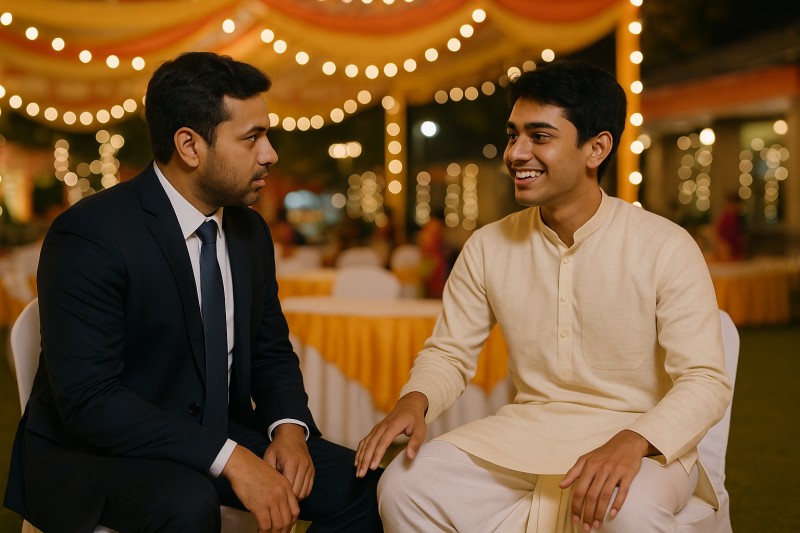
I sat again, observing the stage, food court, photo booths. Amongst all that, my eyes landed on a young man sitting a row ahead—probably 21. He wore a plain white T-shirt with a pocket and jeans. He stared at me like he’d known me forever—and smiled twice. I felt awkward and moved toward the food court.
I stared at the momos being steamed. Suddenly, I noticed him again—smiling at me.
I walked up fast.
“O brother, do I know you?” I asked.
“No, Dada. But you look so happy,” he replied, still smiling.
“What do you mean?” I asked, a bit sharply.
“Nothing. You seemed happy, so I smiled. Simple,” he said.
“Okay, I get it. But now, can you please stop?” I said.
“Dada, sit here. Let’s talk,” he said, tapping the seat beside him.
“Fine! Now what?” I grumbled, but sat down anyway—for my parents’ sake.
He introduced himself. Ashish. A college student. Ranked 2nd in the Higher Secondary exams in West Bengal. Spoke confidently.
I had judged him too soon. Initially, I thought he was odd. But as we talked, I realised—he was content. Genuinely happy. And he saw happiness in me that even I hadn’t noticed.
I told him a bit about my life, how my parents were obsessed with getting me married. He laughed, said they sounded adorable. His energy was contagious.
“Okay, Ashish, nice meeting you, brother,” I said, standing up as I saw Baba approaching.
“Dada, you’re so friendly. Nice to meet you too,” he smiled, turning away.
“Ashish, I thought you were a stupid fellow staring at me, but you are…”
“Yes, I know. People think that. But you know what? Life is meant to be felt and enjoyed. Let people think what they want. Good night,” he said and left.
We had dinner, wished everyone goodbye, and returned home.
“The marriage was nice,” Maa said and went to bed.
“I’m going to sleep. Good night,” I said and headed to my room.
NEXT DAY
“Oh God, these children these days!” Dad shouted from the living room. I could hear the news channel blaring.
I walked out and wished him, then freshened up and came back.
“What happened?” I asked.
“See this! Kids are dying for no reason!” he said, pointing at the TV.
The reporter’s voice cut in:
“Ashish Choudhury, a student of the University of Calcutta, has died by suicide. He attended a wedding yesterday and returned home safely. But this morning, when his neighbour knocked and received no answer, he broke open the door and found Ashish hanging from the ceiling fan…”
My phone slipped from my hand. I froze.
“What’s wrong?” my father asked, tapping my shoulder.
I got up silently and went to my room. My mind replayed everything. That boy—so full of life, so cheerful. How could he be gone?
My eyes welled up. I held it in.
The last time I cried was when I lost my job. People say men don’t cry—but sometimes, they cry not for themselves, but for someone they barely knew. Like me—for a happy stranger.
I remembered his exact words:
“Life is to feel and enjoy. Let people think.”
“Rest in peace, brother,” I whispered.
And at last, I understood—
SOMETIMES, OUR EYES EVEN LIE.
Disclaimer:
This is a work of fiction. Names, characters, places, and incidents are the product of the imagination and used fictitiously. Any resemblance to actual persons, living or dead, or actual events is purely coincidental.