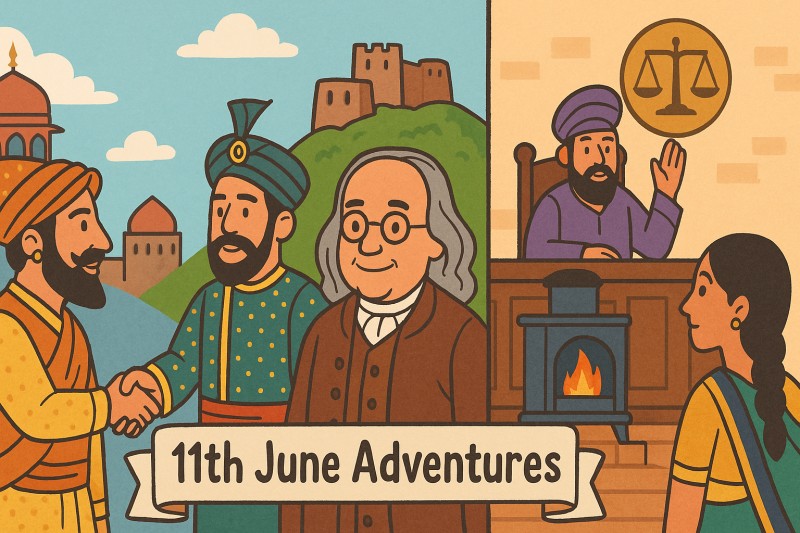

Discover the exciting historical events of 11th June! From Shivaji’s daring treaty with the Mughals to Benjamin Franklin’s clever stove invention and the birth of the Agra High Court—explained in a fun and engaging way for young minds.
Dear Young Explorers,
Today, let’s hop onto our magical history time machine and whizz through the wonders of 11th June—a day that holds not one, not two, but three exciting chapters from the past! Buckle up—there’s a warrior, a courtroom, and even a clever invention involved!
⚔️ 1665 – Shivaji’s Journey to the Mughal Court
Once upon a time, in the year 1665, the Maratha leader Shivaji found himself in a tricky situation. He had been battling the mighty Mughals, who ruled over much of India. But then came a twist in the tale—a treaty was signed on 11th June between Shivaji and the Rajput ruler Jai Singh I, who was fighting for the Mughal Emperor.
This important agreement, known as the Treaty of Purandar, meant that Shivaji had to give up 23 of his 35 forts. That’s like handing over almost two-thirds of your castles! But don’t be too quick to frown—Shivaji cleverly kept 12 forts and even secured a military position for his young son, Shambhaji. It was a chess move in the game of empires!

🔥 1742 – Benjamin Franklin’s Toasty Invention
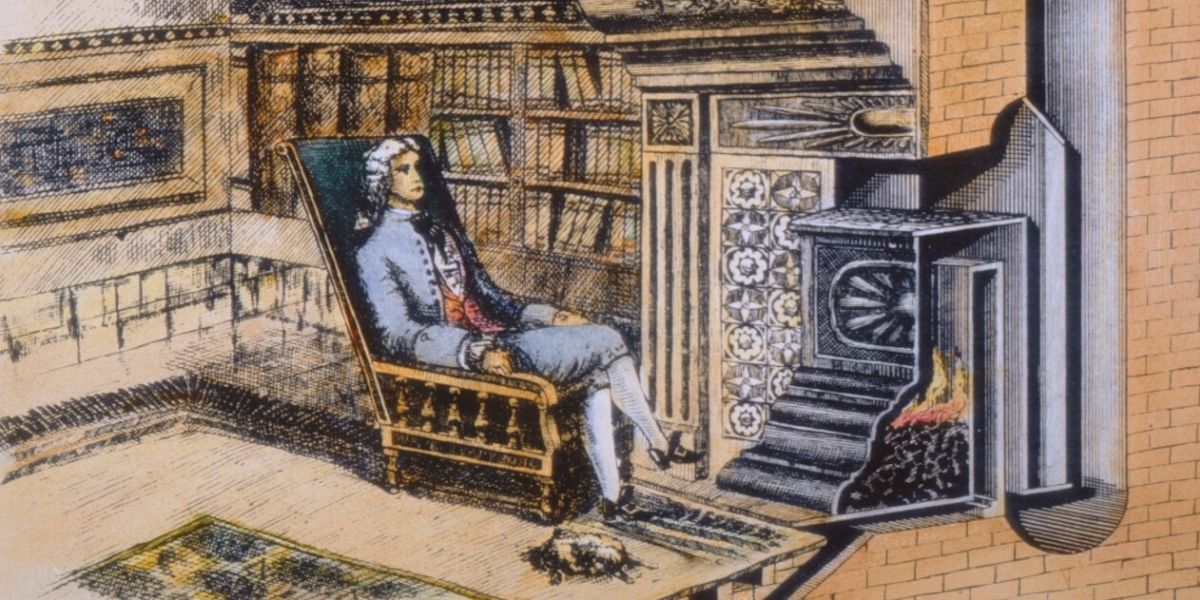
Now, imagine a cold winter night. The fireplace is crackling, but instead of warming your toes, all the heat is being gobbled up by the chimney! That was the problem—until 11th June 1742, when the clever inventor Benjamin Franklin designed a brand-new type of fireplace: the Franklin Stove.
It didn’t look like a dragon or a robot, but it was far more efficient. It used less wood, gave more warmth, and made homes cosier than ever before. What a hot idea, right?
So next time you’re near a heater or a fireplace, you might want to whisper a quiet “thank you” to Mr Franklin!
⚖️ 1866 – A Court is Born in Agra!
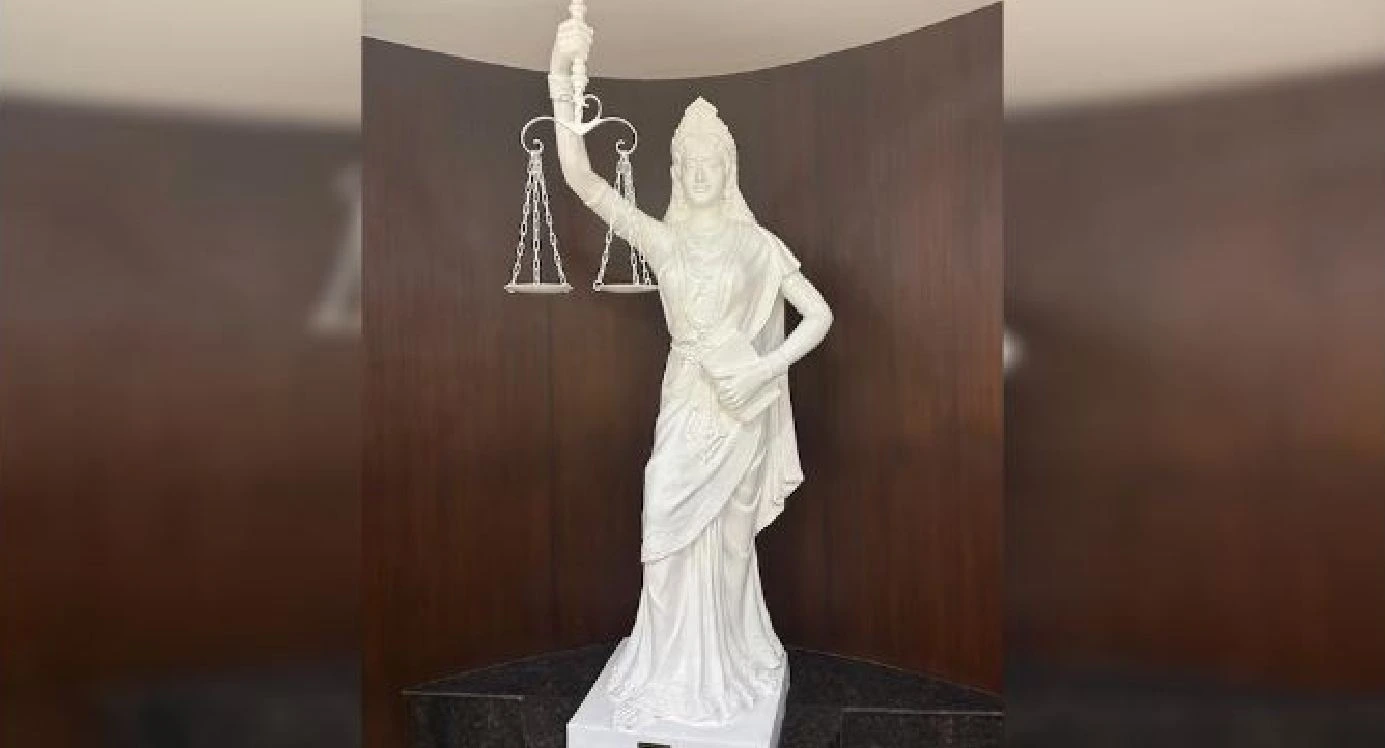
And now we arrive at 11th June 1866, when a grand institution called the Agra High Court (now known as the Allahabad High Court) came into existence.
You may know about courts today, with judges, lawyers, and people seeking justice. But did you know that ancient Indian courts were just as fascinating?
Long ago, there were different layers of courts—family courts, village councils, and right at the top, the King’s court! They solved disputes using a mix of sacred texts, royal commands, village customs, and even common sense. Imagine your family elders settling a fight between you and your sibling over who gets the last laddoo—that’s a mini ancient court for you!
🎒 What Can We Learn?
Every date in history hides a treasure chest of stories. Shivaji teaches us about bravery and clever thinking. Benjamin Franklin shows how a simple idea can warm millions. And the High Court’s origin reminds us that justice and fairness have always mattered.
So, dear students, the next time someone says history is dull, just tell them: “Not True at all!”
Happy learning,