Aarushi Sinha of class 5, shares a story of a young girl named Ruchika who uncovers the truth about a leopard feared by her village—a truth that could save both the animal and its owner, Rohan. This heartfelt tale explores themes of fear, compassion, and our connection with nature.
The entire village had banded together to slay the leopard that had started circling the nearby hills. But I knew something no one else did. As dangerous as the leopard was believed to be, no one actually wanted to find themselves anywhere near it.
My name is Ruchika, and I live in a village called Mari with my parents. I had noticed that the people in our village were not particularly fond of animals—especially not this leopard that had been roaming around.
What I knew, no one else did: this leopard was not a wild predator. It was a pet, and it belonged to a man named Rohan. Rohan was someone who truly loved animals.
But the villagers, who disliked animals in general, wanted to kill the leopard. I decided to convince them not to kill it, since it was actually tame and harmless. But things took a darker turn—the villagers not only wanted to kill the animal, they also decided to kill Rohan.
To be honest, I had always been a little scared of Rohan. He was a quiet boy who rarely interacted with anyone. He often went out of the village into the forest. One day, when I lost my way just outside the village, I tripped and hurt my leg. That was when I saw the leopard. I wanted to run, but my injury made it impossible. I thought it was the end of my life.
But to my surprise, the leopard did nothing. Instead, it came near me and looked into my eyes. Its expression wasn’t ferocious—it was sympathetic. And then, a boy appeared from nowhere and said, “Don’t worry, the leopard won’t harm you. He’s my friend.”
“Your friend?” I asked, quite surprised.
“Yes. Now, let me look at your wound.” Saying this, the boy began applying some herbs he had carried from the jungle. To my amazement, the wound healed almost immediately.
“I’m so glad you came by,” I said gratefully. “What’s your name?”
“I’m Rohan.”
That was how I met Rohan and his leopard. But when I later found out that the villagers were planning to kill them—by burning them alive—I became deeply concerned.
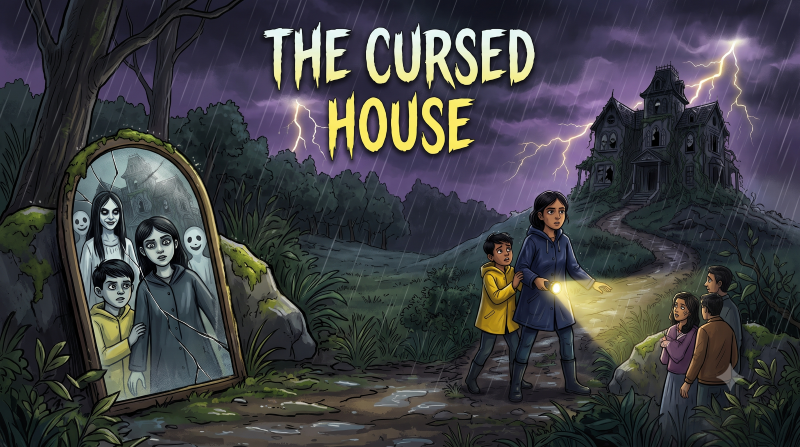
“I have to save them,” I told myself, and set out in secret. I saw the villagers gathered in a meeting, armed with flaming torches made of wood, cloth, and kerosene. I ran toward Rohan’s house, making sure no one saw me. When I arrived, I was out of breath.
“What happened, Ruchika? You look terrible,” Rohan said.
“Quick, there’s no time to explain—you have to run! They’re coming to kill you!”
“Who?” asked a confused Rohan.
“The villagers! They want to kill you and the leopard.”
“But why?”
“There’s no time—just trust me!” I couldn’t finish my sentence, because just then we heard the villagers chanting: “KILL THEM! BURN THEM!”
“Let’s go through the back door—quick,” Rohan advised. The three of us—Rohan, his leopard, and I—ran into the forest.
Meanwhile, the villagers burned down Rohan’s house and rejoiced, thinking they had succeeded in killing Rohan and the leopard.
We watched from a distance. Finally, Rohan said, “Animals don’t harm us if we don’t harm them.”
I looked at the leopard. The gentle look in his eyes was gone—he looked angry, as though he wanted to take revenge. But Rohan remained calm.
“Don’t be angry,” he said to the leopard. “They’re just ignorant about nature and animals. That’s why they tried to kill us. But one day, people will understand the value of nature and begin to care.”
I stood there, wondering when that day would come, as Rohan and his leopard disappeared into the forest. Slowly, I walked back home.