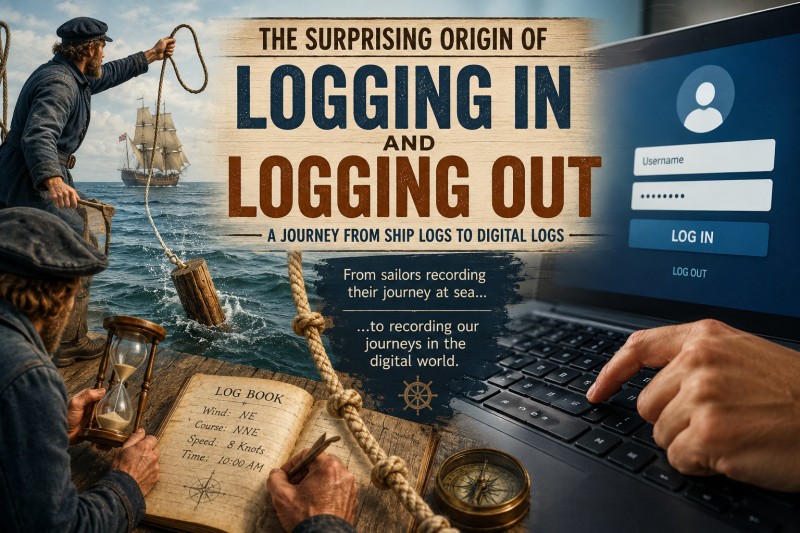

Discover the fascinating 400-year-old history behind the terms “logging in” and “logging out.” Learn how British sailors measured a ship’s speed using a wooden log and how this maritime practice influenced modern computing terminology.
Have you ever wondered about something? Do you have any idea why it’s called “logging in” and “logging out”? If not, then this article is just for you!
Most of us are very familiar with the terms “logging in” and “logging out,” but very few of us know that these common terms have such a fascinating history. Well, there’s no point in blabbering, so let’s get straight to the point!
About 400 years ago, when the British had conquered much of the world, sailors used a device called a “log” to measure the speed of a ship. Needless to say, we already know that a log is a piece of wood. Now, you’re probably wondering, “What does this have to do with logging in and logging out?” Surprisingly, there is a connection.
The 17th-Century Concept
To track their position on the open seas, sailors would tie a long rope to a piece of wood. The rope had knots tied at precise intervals, traditionally 47 feet and 3 inches apart. This is exactly why water speed is measured in knots!
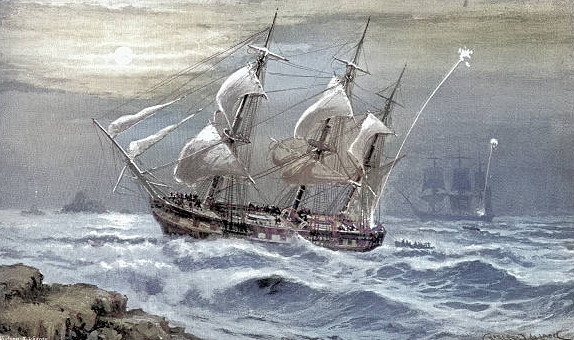
Let’s take a look at how the process worked.
How the British “Logged”
A sailor would stand at the back of the ship and throw the log into the water. Due to a lead weight attached to it, the piece of wood would float vertically, biting into the water and allowing it to stay relatively stationary while the ship sailed away.
The moment the wood hit the water, a second sailor would flip a 28-second sandglass.
Meanwhile, a third sailor would let the rope slip through their fingers while counting the knots that passed by until the sand ran out. If eight knots passed in 28 seconds, the ship was considered to be moving at “8 knots” (eight nautical miles per hour).

There was one final step. Immediately afterward, the officer on watch would record the speed, along with the wind direction and compass heading, in a wooden-bound journal called the “logbook.”
Even today, logbooks are used for official record-keeping. For example, details about the ownership of a vehicle may be recorded in a logbook.
As technology evolved, the concept of “logging” was adopted by the computing world. “Logging in” came to mean recording the start of a user’s session in a digital record, while “logging out” meant ending that entry.
And that is how these 17th-century terms are still used today!
So, the next time you log in to something, remember that the phrase traces its origins back to sailors recording their journeys at sea over 400 years ago.