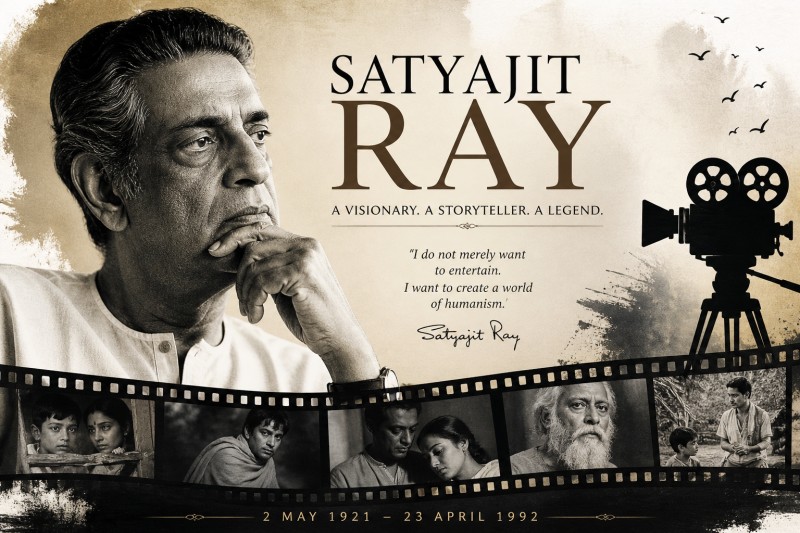

A heartfelt tribute to Satyajit Ray on his birth anniversary, exploring his timeless films like Hirak Rajar Deshe and Agantuk, and how his storytelling continues to inspire generations.
The birth anniversary of Satyajit Ray is a moment of pride and remembrance for India and the world of cinema. Born on May 2, 1921, in Kolkata, he was not just a filmmaker but also a writer, illustrator, music composer, and a true pioneer of artistic excellence. His life and works continue to inspire generations, making him one of the greatest storytellers in global cinema.
There was a time when I, too, was unaware of his magical creations. It was on a fine Sunday afternoon during one of our creative classes when Somashis Sir asked me about him.
My answer was rather simple and somewhat silly—I replied, “He was a Bengali filmmaker.”
Sir enquired, “Is that all?”
We kept staring at him, clueless. Then he decided to show us a film. Honestly, for a moment I thought it might be boring to watch an old Bengali movie, didn’t I?
But, gathering all my courage, I decided to watch it. As he started the video, the title appeared—Hirak Rajar Deshe.
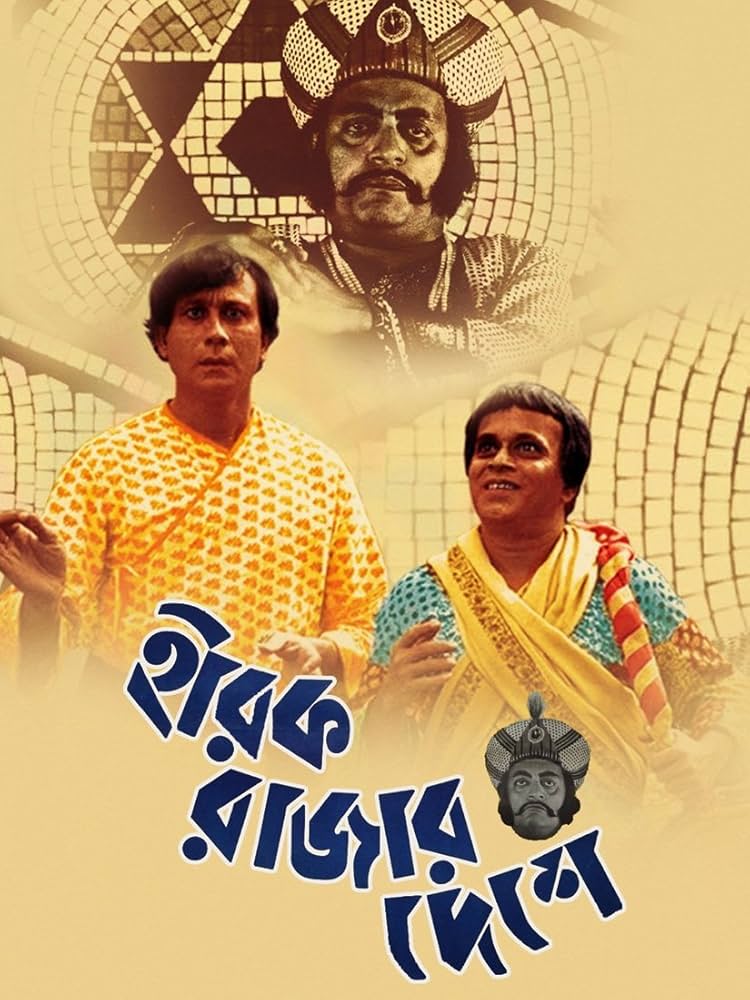
The story takes place in the kingdom of Hirak, ruled by the tyrannical king, Hirak Raja. He is obsessed with wealth and power and uses his resources to control his people. Anyone who dares to oppose him is sent to a secret chamber where their minds are “washed,” forcing them to obey the king without question.
Among the guests at the annual ceremony in Hirak Rajya were Goopy and Bagha—the Jamais (sons-in-law) of the King of Shundi and respected musicians. As they explore the land, they discover the suffering of the common people under the king’s oppressive rule. They also meet a brave schoolteacher, Udayan Pandit, who secretly resists the king and inspires others to stand up against injustice.
After watching this film, I felt as though I had stepped into a magical world of songs, stories, and so much more—far beyond my expectations.
The characters completely won my heart. Goopy Gyne and Bagha Byne are fun, kind, and clever. As the sons-in-law of the King of Shundi, they are remarkable musicians who were gifted three boons by the King of Ghosts:
- 1) “Jay chai porte khaite pari” (They could eat and wear whatever they wanted.)
- 2) “Jay khane khushi jaite pari“ (They could travel anywhere with their magical shoes.)
- 3) “Sa Ni Dha Pa Ma Ga Re Sa, Gaite pari” (Their music had the power to mesmerise anyone who listened.)
However, my favourite character was Udayan Pandit. He is brave and stands up for what is right. He fights against the oppressions of the king and finally with the help of Gopi and Bagha overthrows Hirok Raja.
To be honest, after watching such an incredible film, many Bollywood movies now seem rather uninteresting to me.
After this, I watched another film, Agantuk, and it made me question myself: “Do we trust too little?” and “Do we judge people too quickly?”
Overall, it was a simple yet deeply meaningful film. It amazes me how rich Bengali culture is, and yet how much of it we are still unaware of.
This is how Satyajit Ray did not remain just a filmmaker in my heart—he became a feeling, a hero who changed my way of thinking.
Satyajit Ray passed away on April 23, 1992, but his legacy lives on. His films are studied in film schools worldwide and continue to influence filmmakers across generations.
On his birth anniversary, we remember not just a filmmaker, but a visionary who brought Indian stories to the global stage with honesty and artistry. His life teaches us that creativity, dedication, and a deep understanding of humanity can create timeless masterpieces.